Research software for chemical physics

Electronic structure and quantum dynamics in Python.

Build molecular models, follow quantum dynamics, and explore spectra with an open Python framework for chemical physics.

  • PyQED 0.3.0
  • Python 3.10–3.13
  • MIT
pip install pyqed
quickstart.py
from pyqed.qchem import Molecule

mol = Molecule(
    atom="H 0 0 0; H 0 0 0.74",
    unit="angstrom",
    basis="sto-3g",
)
mol.build(eri="auto")

mf = mol.RHF().run()
print(f"RHF energy: {mf.e_tot:.8f} Ha")

ExpectedRHF energy: -1.11675931 Ha

Choose a starting point

What you can do with PyQED

Choose a field and start with a small, runnable example.

01Core path

Electronic structure

Build H₂, run native RHF, and print a converged total energy.

Requirements and details

Start with molecular construction and native integrals, then continue into MP2, CI, CASCI, and CASSCF research workflows.

≈5 min

Prerequisites
Core PyQED install
Expected result
RHF energy: −1.11675931 Ha
02

Nonadiabatic dynamics

Propagate a two-state avoided crossing with LDRFG.

Requirements and details

Learn the locally diabatic representation on a small model before moving to molecular state surfaces, linked overlaps, and sparse grids.

Starter model

Prerequisites
Core install · NumPy/SciPy
Expected result
State populations against an exact grid reference
03

Open quantum systems

Follow dissipation and environmental memory in a spin–boson HEOM model.

Requirements and details

Use Lindblad, Redfield, and hierarchy methods to evolve reduced density matrices and study relaxation and decoherence.

Starter model

Prerequisites
Core install · model parameters
Expected result
Time-dependent populations and coherences
04

Nonlinear molecular spectroscopy

Explore two-photon absorption and multidimensional optical signals.

Requirements and details

Build nonlinear response from molecular energies and transition dipoles using sum-of-states and correlation-function approaches.

Response functions

Prerequisites
Core install · energies, dipoles, and linewidths
Expected result
Frequency-resolved nonlinear molecular response
05

MPS & DMRG

Construct a fermionic MPO with automatic Jordan–Wigner strings.

Requirements and details

Continue from operator construction to MPS, DMRG, TDVP, symmetry-aware algorithms, and optional active-space workflows.

Starter MPO

Prerequisites
Core install · PySCF optional for DMRG-SCF
Expected result
An inspectable many-body operator and bond structure

Research APIs and method coverage are evolving.Review method and benchmark scope →

Selected research

Computed with PyQED.

Explore the calculations, source code, and methods behind these research figures.

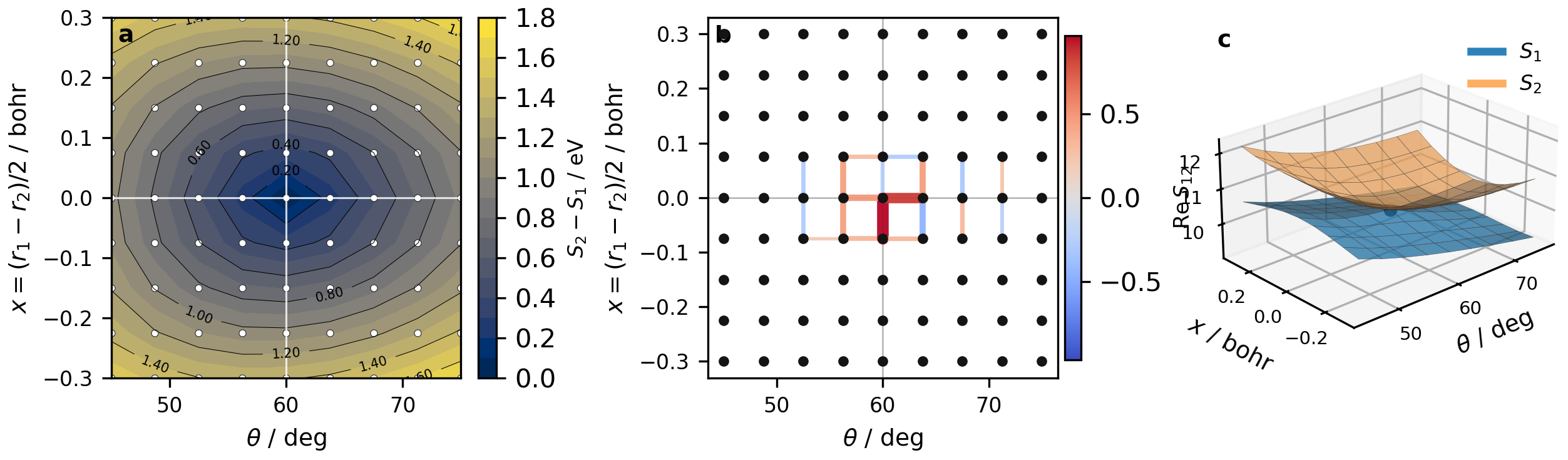
Three-panel H3-plus plot showing an S1–S2 energy-gap contour, a colored overlap-link grid, and two adiabatic surfaces.

Electronic-state topology

H₃⁺ near an S₁/S₂ crossing

Energy-gap topology, overlap links, and adiabatic potential-energy surfaces along coupled nuclear coordinates.

Calculation details
Parameters
AM1/MECI · S₁/S₂ topology · linked-overlap scans
Availability
Related public scans are linked; the exact plotted output archive is not yet published.
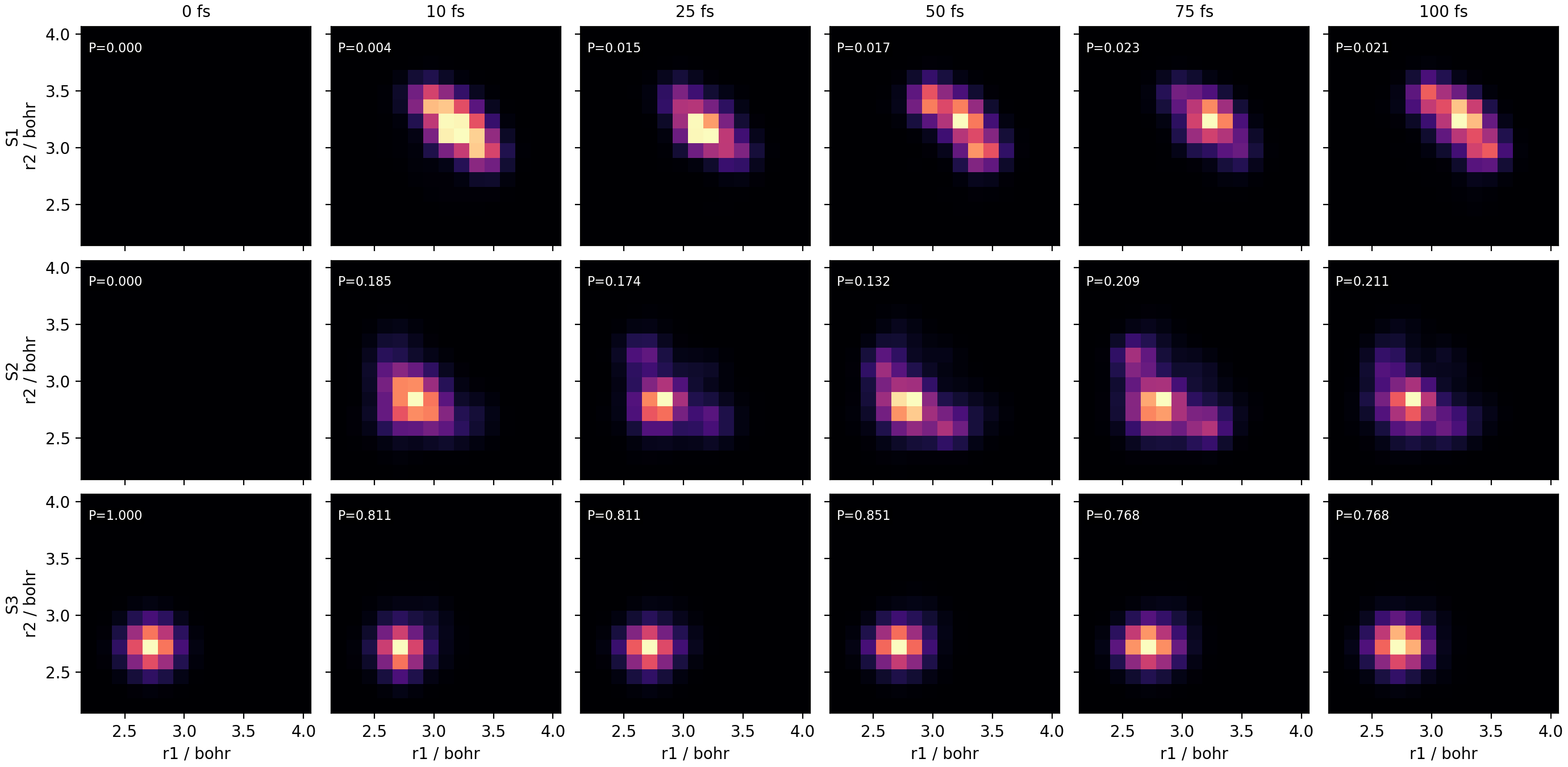
Eighteen heat maps tracking SO2 nuclear probability in r1–r2 coordinates on three electronic states from 0 to 100 femtoseconds.

Nonadiabatic dynamics

SO₂ state-resolved wavepackets

Nuclear probability moves across three coupled electronic states over a 100-femtosecond trajectory.

Calculation details
Parameters
Three states · 15×15×9 grid · 100 fs propagation
Availability
The calculation source is public; the exact output bundle is not yet archived.
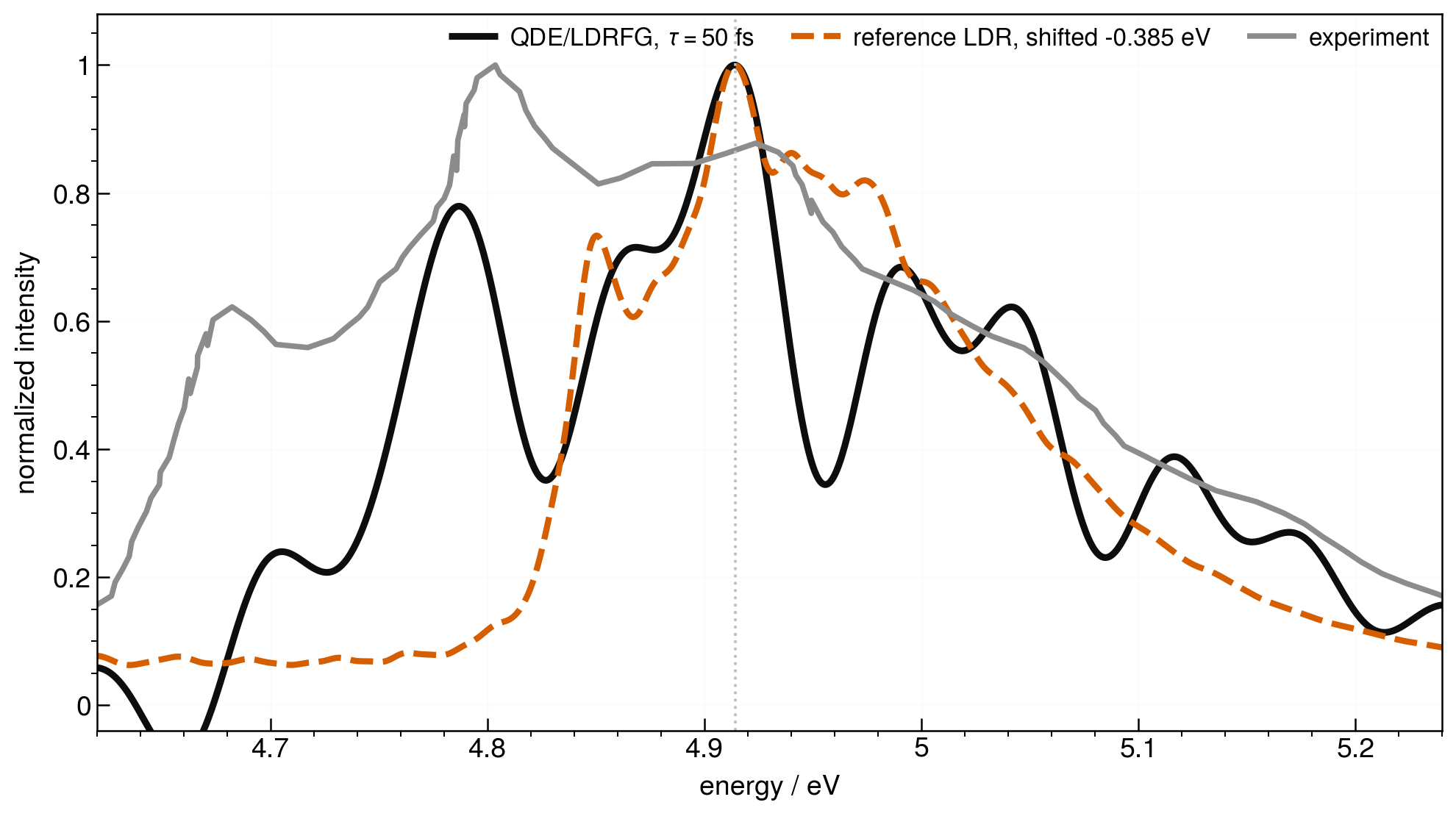
Normalized pyrazine spectral curves comparing QDE/LDRFG, a shifted LDR reference, and experiment between about 4.65 and 5.25 electronvolts.

Spectroscopy

24-mode pyrazine spectrum

A QDE/LDRFG spectrum shown alongside a shifted LDR reference and experimental line shape.

Calculation details
Parameters
24-mode LVC model · 80 fs spectrum · source-controlled simulation
Availability
The simulation source is public; the exact plotted NPZ archive is not yet published.

About the project

Open source for chemical physics.

Maintained by Bing Gu · MIT license

Cite PyQED

PyQED: A Python Framework for Ab Initio Geometric Quantum Dynamics
Yujuan Xie, Xiaotong Zhu, Bing Gu · Chinese Journal of Chemical Physics (2026)

DOI: 10.1063/1674-0068/cjcp2510161 ↗
Validation and release information

H₂ RHF difference from PySCF

1.13 × 10⁻¹⁰ Ha · A scoped STO-3G comparison against PySCF 2.12.1 passed its 10⁻⁹-hartree tolerance. Inputs, raw output, hashes, and limitations are recorded.

Inspect the validation record ↗

One installable research release

Python 3.10–3.13 · Platform wheels and a source archive are published on PyPI. Optional scientific backends are documented separately from the native core path.

Review installation options ↗

Tagged source and verified publishing

v0.3.0 · Release artifacts are connected to tagged source, checksums, workflow records, and PyPI provenance attestations.

Read the 0.3.0 release ↗